Tuesday, 19 March 2013

Autistic Boy Wins 7th Arte Laguna Prize

Series Boys in a City Park was an evolution from the images of injury photographed in the Hospital Gardens in and around Donetsk, Ukraine during a summer residency in 2011 with IZOLYATSIA Foundation for Cultural Initiatives. The broken limbs in Hospital Gardens were an overt metaphor for an emotional fracture, but I was seeking an evolution towards something beyond that and less easily defined; a hidden damage.

My assistant and translator Yulya Shato contacted some different mental health organisations in Donetsk, one of which was a small support group for parents of autistic children. We arranged to meet them in a park in the centre of Donetsk.

It was a blisteringly hot and sunny day; close to 36º.  When we arrived at the park, nothing seemed 'out of the ordinary', people were going about their business and children and parents were playing on the swings and sandpits. We waited for sometime before realising that the parents and children playing were in fact our potential subjects. As we introduced ourselves I watched the children and could not see any indication of their condition or how it might visualise itself.

Only at the point of shooting, exposed to the camera, did the extraordinary complexity of autism as a relative condition reveal itself. During the impossible battle to position the children, their detachment from our reality became startlingly and movingly evident but it was only in hindsight, viewing the chaotic frames, that some of their intimate world was exposed.

Many thanks to Arte Laguna Prize 12.13.

'Boy #1, from series Boys in a City Park, UKR  /IZOLYATSIA © Richard Ansett 2011- Overall Winner - 7th Arte Laguna Prize 12.13 

Saturday, 16 March 2013

Tea with Peggy Guggenheim

Richard Ansett is Peggy Guggenheim with 'L'angelo della Citta, Marino Marini, circa 1948.' - Guggenheim Collection, Venice

Wednesday, 13 March 2013

A Bird in the Hand

Here's a copy of the flier for the upcoming show of two separate but related new projects.

'Untitled' showing in the ground floor space is not a cop out title, it literally does not have a title or narrative in the conventional sense; it takes inspiration from Irving Penn's 'Women of Rissani, Morroco, 1971'. On the lower ground floor we are showing 'Lion Hunting in Essex'.

Opening night is Thursday 4th April. 7-9pm. All welcome.


Tuesday, 5 March 2013

Happy Anniversary Iraq

It feels like I am constantly being reminded that it is now 10 years since the start of the war with Iraq. I do not want to disrespect the suffering of the Iraqi people so I'll get some statistics out of the way first.

SourceCasualtiesTime period
Associated Press110,600 violent deathsMarch 2003 to April 2009
Iraq Body Count project110,937–121,227 civilian deaths from violence. 172,907 civilian and combatant deaths[1][2][3]March 2003 to December 2012
Iraq Family Health Survey151,000 violent deathsMarch 2003 to June 2006
Lancet survey601,027 violent deaths out of 654,965 excess deathsMarch 2003 to June 2006
Opinion Research Business survey1,033,000 deaths as a result of the conflictMarch 2003 to August 2007
WikiLeaks. Classified Iraq War Logs[1][4][5][6]109,032 deaths including 66,081 civilian deaths.[7][8]January 2004 to December 2009

This anniversary partly can give us time to reflect on where we were then and the politics that bullied us into such a doomed conflict.The events leading up to the invasion culminating in the tragic and shocking death of Dr David Kelly, still resonates with me like something out of Stalin's Russia.

In 2010, I was asked to photograph the journalist Andrew Gilligan, we had arranged to meet outside a major Mosque in east London as part of story about Muslim extremism but he didn't show. It transpired that he was still in bed with the flu and had completely forgotten about the shoot. With some reticence he agreed to allow me to come very briefly to his home, as the press deadline was the next day.

When I arrived, I was greeted by the poorly fellow and was shown into his lounge which was a mess of books, papers, empty sweet wrappers and fizzy drinks bottles. It is an enormous privilege and buzz as a photographer to see the unrefined reality of someone else's life, there is much to learn from it. He sat for me for 10 minutes and I left.

I have always expected that Gilligan's role in the Iraq conflict would make him more of a celebrity but it seems he has quietly been working as a journalist in relative obscurity ever since his dismissal from the BBC. I did feel I was in the presence of an important protagonist that gave the government and especially Alastair Campbell a sharp poke in the ribs. I still believe history might make more of Gilligan but all the players in this grubby affair will never be able to completely wash away the blood  whether it is Iraqis' or Kelly's. They are rather macabre celebrities.

The National Portrait Gallery, London has a very dogmatic approach to its acquisitions; the subject must have earned their place in some way that they decide. Often it is celebrity that attracts their interest or those who have achieved some greatness in their field. It is an indication that I am not alone in my feelings about Gilligan and therefore no accident that they deemed his image worthy of a place in their historic collection. 

In the bottom left hand corner of the image by entire coincidence is the book 'The Country Formerly Known as Great Britain'. by Ian Jack.
Andrew Gilligan © Richard Ansett 2010 / National Portrait Gallery Permanent Collection


Detail from Andrew Gilligan © Richard Ansett 2010


Saturday, 23 February 2013

Immediate Nostalgia

'Tress Marked for Felling' (Consequences of Change) (larger version) is an extended title included after discussion with Kate Ware, curator at the Museum of Art, New Mexico. Although the images (below) are included in an ostensibly environmental show at PhotoPlace Gallery, the piece was created primarily as more of an emotional and psychological exploration.

When developing a new piece of work, it is very hard to understand in the present moment whether it has any legacy. The attachment to the moment of creation inhibits the ability to see objectively, so it feels like a big risk to show work so recently created.

Completed images and ideas must sit sometimes even for years before they can be developed or shown. In the medium of photography, there is pressure to expose the 'immediate present' which of course is impossible but the expectation is a bi-product of our engrained processes of viewing. Susan Sontag brilliantly summed up the paradox of the photographic process as a form of 'immediate nostalgia.' This piece and much of my current practice is directly inspired by that notion.

I have been interested in the concept of non-literal 'markers' or signs and the relationship between their abstract and actual meaning. This can be interpreted in many ways but in this context I am attempting to expose unseen timelines; emotional markers that influence present and future actions.

"We had a big woods and farm behind our house (someone else's property) that was a very important place to me. While I was young, the land was sold for a housing subdivision. My brother and I were outraged and devastated by the colorful markings with paint and plastic flags that signaled the end of our "wilderness." We'd come home from school to find these and the tire tracks of large construction vehicles." - Kate Ware, Curator of Photographs, Museum of Art, New Mexico

Other personal stories;

"It (sic) reminds me of coming home and the feeling of immense sadness on seeing the beautiful big tree outside our flat, a Victorian like the tenements, with the mark of death daubed across it's trunk. In the end nature beat them to it when a gale hari kari'd it across the street."

"This happened in some woodland I loved to walk in some years back. The fellers were really ruthless wanting to take out masses of beautiful old trees, so a friend and I went round and removed the marks on a couple of our favourites!"


Tress Marked for Felling (Consequence of Change),  Dec 2012 © Richard Ansett


Winter Timber, 2009 - David Hockney

Wednesday, 6 February 2013

Heimat


The mono-cultural landscape of Berchtesgarten, Bavaria stirs up inevitable memories of its recent history. These mountain scenes though are unchanged; it is the same now as it was before the virtues of mountain air and physical fitness were hijacked for the ideology of the Third Reich.
Many tourists come in their coach loads from all over the world to see the stunning views from the ‘Eagle’s Nest’ (given to Hitler on his 50th birthday by the NSDAP), now a cafe selling inoffensive pens and snow globes but the association with its Nazi past is strong and the big crowds are drawn to the landscape as a metaphor of horror and political power.
‘People are bound to the concept of heimat by their childhood, language and earliest experiences; it is an 'acquired affinity to the landscape.' Heimat can be regarded as association of identity to stereotypical notions of antecedence, community and tradition.
It is a powerful instrument of self assurance and orientation relative to a perceived notion of an alienating world.’
Mountain Scene, Berchtesgarten, Bavaria © Richard Ansett 2006

Heimat #1, Berchtesgarten, Bavaria © Richard Ansett 2006

Heimat #4, Berchtesgarten, Bavaria © Richard Ansett 2006

Thursday, 31 January 2013

The Gypsy Curse


Transylvania easily dispels the myth of the Victorian Gothic pot boiler but whilst large stretches have been stripped of any charm by the post revolutionary zeal to develop into a modern state, there are isolated pockets, lost in time, where peasants eke out a subsistence living, romantically portrayed as 'low carbon' and ‘moneyless’ rather than poor, by the tourist brochures and travel writers.
Romania has had its fair share of pogrom both under the Nazis and then the Russians, (in Transylvania 8000 villages were completely destroyed by the Ceaucescu regime), they are considered by the outside world and themselves to be the ‘poor man of Europe.’ It is hard to reconstruct a national identity when it seems no-one cares who you are or what you think.
Around the motorway ‘non stops’ there is uneducated superstition.  I refused a gypsy begging by the roadside; a curse feels palpable and personal here just 3 hours away from the secular security of London. They mumble something Hungarian under their breath at you whilst maintaining eye contact and smiling.
As the sun went down, we raced along dirt tracks, dogs chasing and barking at the windows, towards a small village in the heart of Transylvania to dine with a Count, Count Kalnoky and his wife Anna. The Count had a priviedged upbringing in Munich and avoided the Ceauescu regime and was distant and socially awkward but Anna had lived through these terrible times and whilst much more socially engaging, still hid her emotions behind an expressionless gaze. At one point, she stood in the corner, facing into the wall for too long to illustrate her harsh treatment as a child. The butler shared with me "the local peasants think she is a witch".

I threw pálinka into the fire place, the alcohol creating huge flames adding to the melodrama but I drank too much and mixed with my medication, I later lay awake in my room alone, avoiding the whisper of spirits in my ears until dawn appeared through my shutters.
When I returned to London a large black fly flew out of my ear.
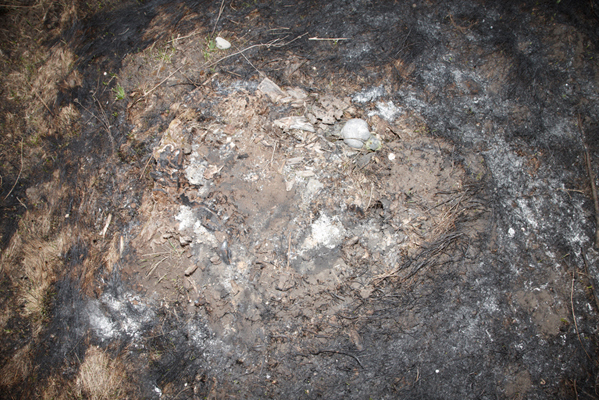
Burnt Ground, Transylvania © Richard Ansett 2011


Girls by the Roadside, Transylvania © Richard Ansett 2011